
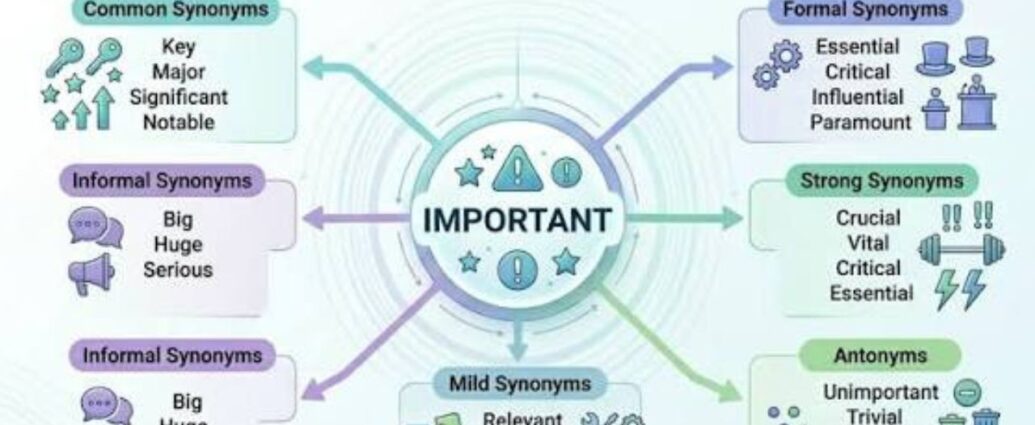
Finding the right important synonym can make your writing clearer, more professional, and more engaging. The word “important” is extremely common in English, but repeating it too often can make sentences sound simple or repetitive. Fortunately, English offers many alternatives, including words such as significant, essential, crucial, vital, major, critical, meaningful, notable, influential, and consequential.
However, synonyms are not always interchangeable. Each alternative can express a slightly different idea. For example, “essential” often suggests something is necessary, while “significant” emphasizes importance or meaning. “Prominent” is commonly associated with a person or thing that is noticeable or influential.
Understanding these differences can help students, writers, professionals, and English learners select the best word for every situation.
What Does “Important” Mean?
The adjective “important” generally describes something that has great value, significance, effect, or influence. It can also describe a person who has considerable power, status, or influence.
For example:
- Education is important for personal development.
- This is an important decision.
- She is an important member of the organization.
- Good communication is important in the workplace.
Because the word has several uses, the best synonym depends on the specific meaning intended.
What Is an Important Synonym?
An important synonym is a word or phrase that has a similar meaning to “important.” Some common alternatives include:
- Significant
- Essential
- Crucial
- Vital
- Critical
- Major
- Meaningful
- Consequential
- Notable
- Influential
- Prominent
- Substantial
- Momentous
- Key
- Fundamental
- Necessary
- Valuable
- Pivotal
- Serious
- Remarkable
These words can make writing more precise, but they should be selected according to context rather than simply replacing “important” everywhere.
Most Common Important Synonym Words
Significant
Significant is one of the closest alternatives to “important.” It can describe something that has considerable meaning, value, effect, or influence.
Example:
The research produced a significant improvement in performance.
Essential
Essential means extremely necessary or required. It is stronger than “important” when something cannot be effectively done without it.
Example:
Clean water is essential for human life.
Crucial
Crucial describes something that is extremely important to the success or outcome of a situation.
Example:
Good planning is crucial to the success of the project.
Vital
Vital means necessary for life, success, or proper functioning.
Example:
Regular communication is vital for a successful team.
Critical
Critical can mean extremely important, especially when a decision or situation could have serious consequences.
Example:
The company needs to make a critical decision before the deadline.
Major
Major is useful when describing something large, serious, or significant in comparison with other things.
Example:
The company announced a major change to its business strategy.
Meaningful
Meaningful emphasizes emotional, personal, or symbolic significance.
Example:
Her advice had a meaningful impact on my career.
Notable
Notable means worthy of attention or deserving to be noticed.
Example:
The scientist made a notable contribution to the field.
Influential
Influential describes someone or something capable of affecting people’s opinions, decisions, or actions.
Example:
She is an influential figure in the technology industry.
Consequential
Consequential describes something that produces important results or effects.
Example:
The decision could have consequential effects on the organization.
Important Synonym for Formal Writing
Choosing an appropriate important synonym can make formal writing more precise. Academic and professional writing often benefits from words such as:
- Significant
- Substantial
- Crucial
- Essential
- Fundamental
- Consequential
- Notable
- Pivotal
For example:
Basic:
This is an important factor in economic development.
More precise:
This is a significant factor in economic development.
Another example:
Basic:
Communication is important for teamwork.
Formal:
Effective communication is essential for successful teamwork.
The best choice depends on what the writer wants to emphasize.
Important Synonym for Academic Writing
Students often use “important” in essays, reports, assignments, and research papers. Replacing some repeated uses with more precise vocabulary can improve the quality of academic writing.
Consider these examples:
- Important factor → significant factor
- Important issue → critical issue
- Important role → crucial role
- Important discovery → significant discovery
- Important contribution → substantial contribution
- Important evidence → compelling or significant evidence
- Important change → major change
Using synonyms carefully can improve variety without changing the original meaning.
Important Synonym for Professional Writing
Professional communication requires clear and direct language. Depending on the situation, words such as critical, essential, significant, key, major, and necessary may work better than “important.”
For example:
Original:
It is important to complete the report by Friday.
Alternative:
It is essential to complete the report by Friday.
Or:
Original:
The manager discussed an important issue.
Alternative:
The manager discussed a critical issue.
The second sentence communicates a stronger sense of urgency.
Important Synonym for Describing People
When “important” describes a person, the meaning can relate to influence, status, reputation, or prominence. Therefore, words such as influential, prominent, eminent, powerful, leading, and distinguished may be appropriate depending on the context. Cambridge lists terms such as “eminent” and “prominent” among related words for this sense.
Examples include:
- an influential leader
- a prominent journalist
- an eminent scientist
- a distinguished professor
- a leading researcher
- a powerful political figure
These words should not be treated as perfect replacements because they emphasize different qualities.
Important Synonym for Describing Things
When describing an object, event, discovery, decision, or idea, the most useful alternatives may include:
Significant: emphasizes importance or meaning.
Major: emphasizes size, scale, or seriousness.
Crucial: emphasizes importance to an outcome.
Essential: emphasizes necessity.
Notable: emphasizes that something deserves attention.
Momentous: emphasizes that something has major long-term consequences.
For example:
- a significant discovery
- a major event
- a crucial decision
- an essential tool
- a notable achievement
- a momentous occasion
Important Synonym vs. Exact Replacement
One of the most important things to understand about synonyms is that similar words do not necessarily have identical meanings.
For example, “important” and “essential” are related, but “essential” usually indicates necessity. Similarly, “prominent” can describe someone who is well-known or influential, while “important” is broader.
Language resources also emphasize that synonym choice depends on context. A word that looks like a synonym in a dictionary may sound unnatural or change the meaning when placed in a particular sentence.
Therefore, writers should consider the exact meaning before choosing an alternative.
Strong Important Synonyms
Sometimes writers want a stronger word than “important.” Several options can communicate a higher level of significance.
Crucial
Suggests that something is extremely important to an outcome.
Vital
Suggests that something is necessary for success, survival, or proper functioning.
Essential
Suggests that something is absolutely necessary.
Critical
Suggests extremely high importance, often in a serious or urgent situation.
Pivotal
Suggests that something plays a central role in determining an outcome.
Paramount
Suggests the highest level of importance.
Indispensable
Suggests that something cannot be replaced or done without.
These stronger terms should be used carefully because they can make a statement more forceful.
Important Synonym List
| Important Synonym | Main Meaning | Example |
|---|---|---|
| Significant | Great meaning or effect | A significant discovery |
| Essential | Absolutely necessary | Essential information |
| Crucial | Extremely important to success | A crucial decision |
| Vital | Necessary for success or life | Vital resources |
| Critical | Extremely important or urgent | A critical problem |
| Major | Large or serious in importance | A major development |
| Meaningful | Having personal or emotional value | A meaningful experience |
| Notable | Worth noticing | A notable achievement |
| Influential | Having strong influence | An influential leader |
| Consequential | Producing important effects | A consequential decision |
| Fundamental | Basic and necessary | A fundamental principle |
| Pivotal | Central to an outcome | A pivotal moment |
| Valuable | Worthwhile or useful | Valuable information |
| Prominent | Noticeable or influential | A prominent researcher |
| Momentous | Very significant, often historically | A momentous event |
How to Choose the Right Important Synonym
Choosing the right word depends on the context.
If you mean necessary, use “essential” or “vital.”
If you mean very significant, use “significant” or “substantial.”
If you mean extremely important to an outcome, use “crucial,” “critical,” or “pivotal.”
If you mean influential, use “influential” or “prominent.”
If you mean emotionally valuable, use “meaningful.”
If you mean worthy of attention, use “notable.”
This approach creates more accurate and natural writing.
Examples of Important Synonyms in Sentences
Here are several examples:
- Education plays a significant role in society.
- It is essential to follow the instructions carefully.
- Teamwork is crucial for completing the project.
- Water is vital for every living organism.
- The company faces a critical challenge.
- The organization made a major investment.
- Her support was meaningful to the team.
- He made a notable contribution to science.
- She became an influential voice in the industry.
- The decision had consequential effects.
Antonyms of Important
Understanding the opposite of “important” can also improve vocabulary. Common antonyms include:
- Unimportant
- Insignificant
- Minor
- Trivial
- Inconsequential
- Negligible
- Unnecessary
- Secondary
- Nonessential
Cambridge lists “unimportant” and “insignificant” among the common opposites of “important.”
For example:
Important: This is an important detail.
Antonym: This is a minor detail.
Why Learning Important Synonyms Matters
Learning an important synonym is useful for several reasons. First, it expands vocabulary. Instead of depending on one common adjective, learners can choose words that express more precise meanings.
Second, synonyms can make writing less repetitive. Repeating “important” several times in one paragraph can make the writing feel basic.
Third, understanding different shades of meaning helps improve communication. A writer can distinguish between something that is merely significant and something that is absolutely essential.
Finally, a broader vocabulary can help students perform better in essays, presentations, examinations, and professional communication.
Conclusion
Learning an important synonym is a simple way to improve English vocabulary and writing skills. Common alternatives include significant, essential, crucial, vital, critical, major, meaningful, notable, influential, and consequential.
However, these words are not always exact replacements. The best choice depends on context and the specific meaning the writer wants to communicate. By understanding these differences, English learners and writers can produce clearer, more varied, and more precise sentences.
Rather than replacing “important” automatically, think about the intended meaning first. Choose essential when something is necessary, crucial when success depends on it, significant when it has considerable meaning or effect, and influential when someone or something has the power to affect others.
Using synonyms with this level of care can make everyday communication, academic writing, and professional content more effective.