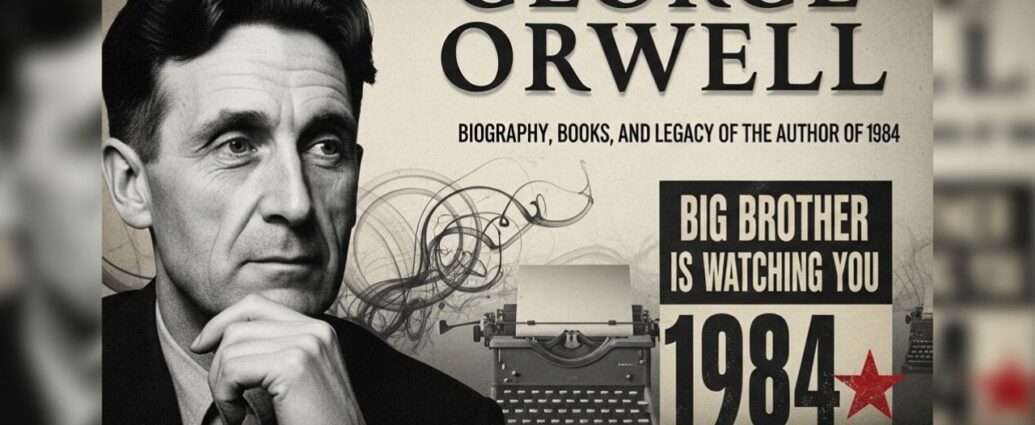
George Orwell was a renowned British novelist, essayist, and journalist best known for his powerful critiques of political oppression and authoritarian governments. Born Eric Arthur Blair on June 25, 1903, Orwell became one of the most influential writers of the 20th century. His works combine clear writing, social criticism, and deep concern for freedom and truth.
Orwell is most famous for his novels 1984 and Animal Farm, both of which remain widely read and studied today.
Early Life and Education
George Orwell was born in Motihari, in British India (now part of India). His father worked in the British colonial civil service.
Orwell later moved to England for his education. He attended Eton College, one of the most prestigious schools in Britain. Instead of going to university, he joined the Indian Imperial Police in Burma (now Myanmar), an experience that later influenced his views on colonialism and power.
Writing Career of
After leaving the police service, Orwell decided to become a writer. He adopted the pen name George Orwell and began publishing essays, novels, and journalism.
His early works often described poverty and social inequality. One example is Down and Out in Paris and London, which recounts his experiences living among the poor.
Orwell’s writing style was known for its clarity, honesty, and strong political insight.
Animal Farm of Orwell
Published in 1945, Animal Farm is a political allegory that uses farm animals to represent figures and events from the Russian Revolution and the rise of authoritarian leadership.
In the story, animals overthrow their human farmer to create a society based on equality. However, the pigs gradually take control and establish a dictatorship.
The book remains famous for its powerful message about corruption, power, and propaganda.
1984
Orwell’s most famous novel, 1984, was published in 1949. The story describes a dystopian society controlled by a totalitarian government that constantly monitors its citizens.
Key ideas from the novel include:
-
Big Brother – the symbol of constant government surveillance
-
Thoughtcrime – punishment for even thinking against the government
-
Newspeak – a controlled language used to limit freedom of thought
The novel warns about the dangers of propaganda, censorship, and absolute political power.
Themes and Influence
George Orwell’s works explore many important themes, including:
-
Freedom and individual rights
-
Political corruption
-
Social injustice
-
Truth and propaganda
His writing introduced several concepts that remain widely used in modern discussions of politics and media, such as the term “Orwellian,” which describes oppressive systems of control and surveillance.
Legacy of Orwell
George Orwell passed away on January 21, 1950, in London, but his influence remains enormous. His novels continue to be read in schools and universities worldwide.
Both Animal Farm and 1984 are considered classics of modern literature, and their warnings about authoritarian power continue to be relevant in contemporary society.
Conclusion on Orwell
George Orwell was a visionary writer who used literature to examine political power, social inequality, and human freedom. Through his influential works, he encouraged readers to question authority and defend truth and democracy. His legacy continues to shape discussions about politics, media, and individual rights around the world.